

Overview
After the completion of my adventures into the Thai alphabet, the next logical step is putting that knowledge to good use – actually reading. So, I decided to drop by the nearby mall and see what books were on offer. As an adult reader, books targeted at toddlers featuring a fully illustrated page and a short sentence comprising 1 word wasn’t what I had in mind, and books for kindergarten children featuring a similarly illustrated page but an upgraded 5 words weren’t quite what I was looking for either. The next step up looked for the most part to be comprised of comics which were illustrated obviously, with a slightly more generous contribution of words. And… that pretty much looked like the selection.
To be fair, there were some very limited books similar to the one listed below.
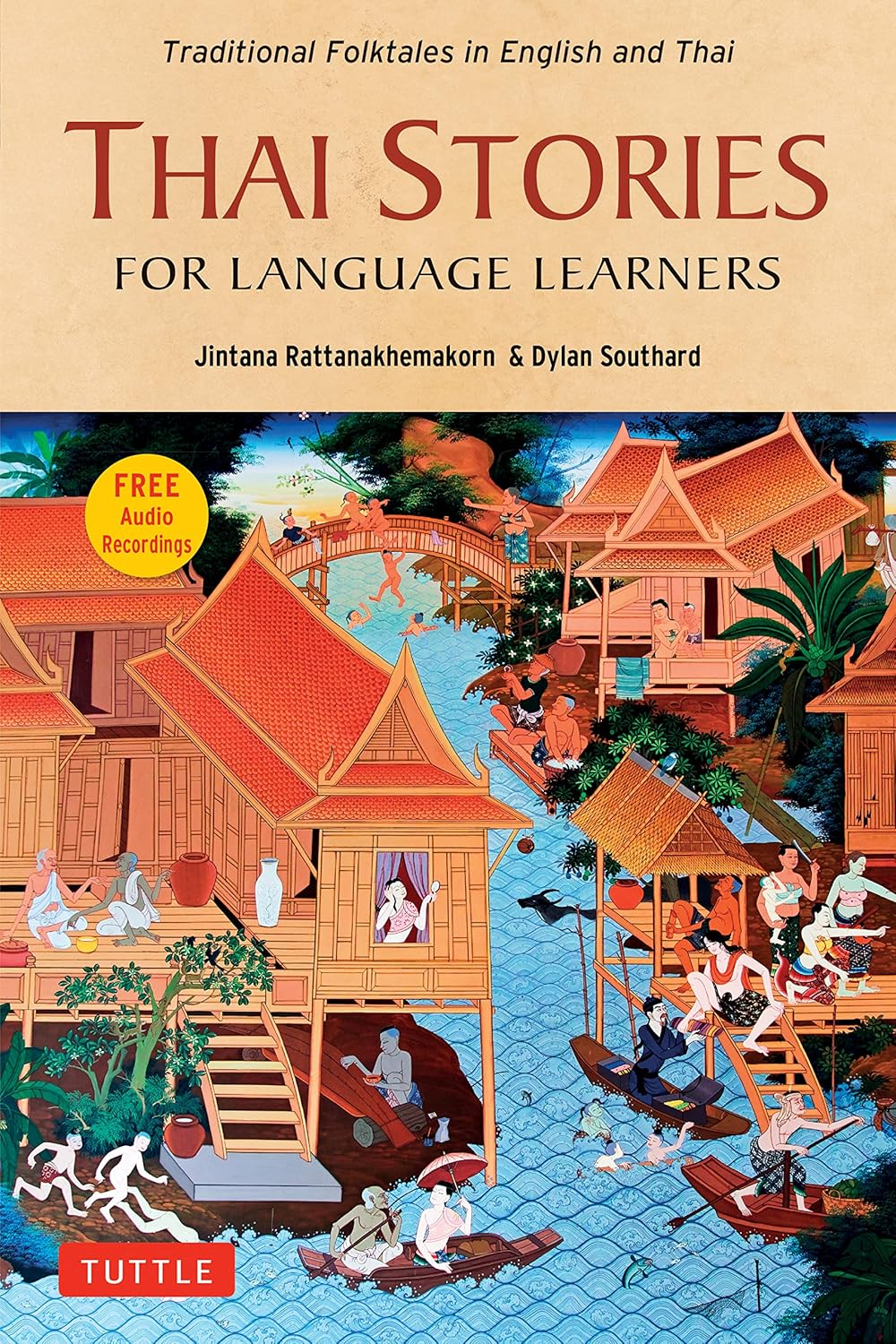
Traditional Thai folk stories rewritten for learners
A graded introduction to Thai through simplified stories, vocabulary lists, and cultural notes — suitable for post-beginner learners.
Buy on Amazon
But, as mentioned… the selection was very limited, and the closest thing I could find were cute books that looked more like they were filled with short motivational passages with (still) a cute illustration of a flower basket than anything with substance.
Now, coming from the Western reading culture, I feel like the difference is enormous in terms of what is available to intermediate readers – not quite children, but not quite teens either. If you know Enid Blyton, Nancy Drew, The Three Investigators; then you know what I’m talking about (well depending on how valued reading was during your youth anyway). These were books and reading materials that were meant for those who knew the alphabet and had some experience with reading beyond Dr. Seuss, and wanted to progress to something just beyond that. Those who weren’t quite ready for the wonders of Stephen King, Terry Pratchett, but needed some scaffolding for them to follow to reach the world of adult literature.
Now, I’m sure with enough searching, maybe I could find the Thai translations of The Three Investigators which I was very fond of when I had a lot less grey hair, but the objective isn’t to read a translation, instead early intermediate Thai literature. Possibly I’m just not very good at searching for books in Thailand, or my neck of the woods doesn’t have that many options, a combination of both… or just there’s a distinct lack of this early intermediate content.
Mind the gap
This isn’t here as a rhetorical question; I genuinely have no idea why there’s a gap in the available literature. I’m sure the gap isn’t as wide in Bangkok, but I believe that is likely due to the fact it’s a melting pot of cultures/races/nationalities as opposed to anything else.
Thoughts:
- Economic – The reading culture is very much one of those things where it’s a Catch 22 – If you don’t have a reading culture, then the market won’t fill the gap, and if the market won’t fill the gap, then there won’t be a reading culture. Ultimately, Thailand does not have enough economic incentive to produce graded intermediate books — the market simply does not exist.
- Technology – The wonders of technology haven’t really helped since a growing percentage (likely a majority) of the younger generation no longer view reading/books as recreation. What happened in between is that the technological revolution came about and became a convenient way to occupy any child that had outgrown their pacifier. The end product is a generation that views books as a relic of the older generation only meant as a brief stepping stone en route to the mobile/tablet if at all.
- Culture – But the younger generation didn’t get this way out of nowhere – I think it just means the prior generation didn’t quite look at reading/books in that way either, and that mindset was just handed down.
Thailand isn’t alone in their jello covered adventure down this slippery slope. Unfortunately, I think Thailand happened upon the perfect storm of all 3; from the outside, Europe seemed to have avoided this partly because its reading culture and economy were already well-established before mobile technology arrived, which meant technology didn’t affect them as much. I can’t speak for the Americas, since I’ve never been though. Most cultures worldwide are similar, although many less-developed Asian regions adopted mobile/tablet parenting more aggressively than Western regions, simply because the economic and educational foundations for a strong reading culture weren’t in place before the technology arrived. The allure of a quiet child pacified by a mobile phone/tablet is one that isn’t easily ignored, but this from my perspective is very short sighted. All three factors reinforce each other, forming a vicious cycle where intermediate reading material simply never emerges.
Regardless of the cause, the result is the same: if you’re an foreigner learning Thai, the jump from basic literacy to real reading is a cliff, not a staircase. The only question is how high of a cliff it is, which is determined by what the reading culture was like during your own upbringing, and what era that culture was formed in. It’s entirely possible that the more youthful amongst us — raised in a world where the reading culture had already begun eroding even in traditionally literate regions — may not feel the same jarring effect.
Adults Only
As an adult learner, I had a brief glance through the books that were relatively obviously meant for those who had recently finished learning (or were close to) the Thai script, gave up, looked at the books meant for intermediate readers, gave up, and found nothing much beyond comics and what I would describe as having very Anime covers but lots of text inside (I assume that these are the equivalent of Mills & Boom from the 80s/90s?). Conclusion, I gave up…
After some discussion with the newest wonder of the world, ChatGPT, I settled on looking at what was available online with suggestions leaning towards academic sources. I chose to avoid general Thai mainstream media and news due to the heavy lean towards what I consider tabloid journalism; there’s only so many times I’m interested in reading about how person X has 2 wives, or some variation of a bizarre love triangle. I ended up focusing on the101world, matichon, etc.
My first foray into literacy was this article from the101world – “อารมณ์กับตัวตนคนรุ่นใหม่” กับ สุวรรณา สถาอานันท์. Definitely a bit more challenging than I would recommend for someone who just finished learning the alphabet/script the day before, but at the very least, the content looked to be of interest to me, and interest would help to keep me engaged in the article (outside of me liking to punish myself).
The Process
In preparation, I did the below:
- I copied the entire article into MS Word and removed images/ad text/etc.
- I modified the document to include double spacing throughout
- I increased the font size significantly since I still had trouble identifying certain characters
After all of that, what I started out with was actually manually inserting text boxes over each word I read… word by word. I’ve attached a sample of my Word document below. Each textbox represented a single Thai word, and I would essentially Romanize each Thai word/syllable as I read it with additional notation for certain things such as:
- ( ) – I used open/close brackets to signify implied sounds, so as per the first word อารมณ์ – I Romanized it as aa-r(o)m where the (o) was implied instead of an explicit sound. There is typically either an (o) or an (a) depending on the word origin (you’ll get to that later).
- Red – I marked certain words in red. These were words that I had issues with initially mainly because Thai script doesn’t use spaces to separate words, and let’s just say there were a lot of red markings initially.
- Blue – Not seen in the screenshot below, I marked some words in Blue. These were words that I was able to read, but I had never used before in conversation, or never heard before. Essentially gaps in my vocabulary. For example, กตัญญู – which I’ve never heard before, don’t know the meaning of, and also had issues reading (due to the Pali Sanskrit origins and initial inability to recognize the different word origins).
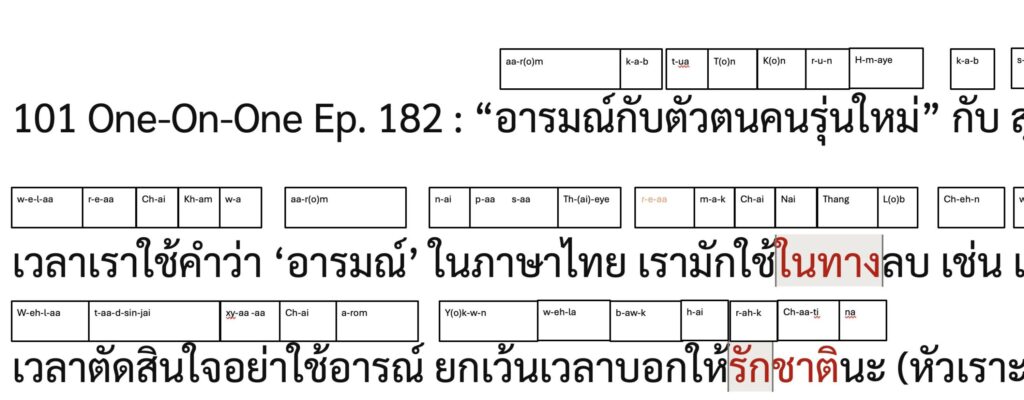
I did this for a few days, but realized that this was extremely time consuming, and not in a good way. A lot of time was wasted on creating, resizing, and aligning text boxes, rather than actually reading.
My evolution of my reading setup was as below:
- As I read and/or ran into issues, I would copy/paste that specific word (thanks to the wonders of MS Word being able to recognize/separate Thai words) into Google Translate. This would allow me to “learn” the mechanics behind that word, how it sounds, the meaning, etc. I’d then go back to my Word document, add my text box/markings, and move on.
- After some time, I decided to move away from this setup purely because of the amount of time being wasted on the textboxes and formatting. At this point, I printed out the entire document, with a second document printed out with only the Romanized Google Translate text. No longer tied to my laptop, I could now read from the printed document, and pull out and cross check against the Romanized print out when I got stuck on something.
- The above setup also had some time wasting issues – where my time was then wasted hunting down the specific paragraph, line, and/or word I was stuck at. The Thai script and Romanized script being on completely separate documents made cross referencing difficult and time consuming.
It was at this point, that I took some time to create an amalgamation of the two. I created a single document that had one paragraph in Thai, and that same paragraph Romanized, before moving on to the next paragraph. This allowed for faster cross referencing on a per paragraph basis, which worked because the majority of the paragraphs were relatively short. - Once I had migrated to traditional paper, with the final version of the worksheet with alternating Thai and Romanized paragraphs:
- I discarded the text boxes because doing it on paper would just move my time wasting from electronic time wasting on MS Word, to physical time wasting as a mucked about drawing text boxes on actual paper
- Instead, I switched to the good ol’ pencil, and started to write out my Romanized text immediately above the double spaced Thai text, while also underlining and inserting a comma between identified Thai words.
- After some time (days), when reading started to become smoother, I then stopped writing down the Romanization above the Thai text, and only kept the underlines and commas – more as an indication that I had “read” that word, rather than anything else.
- I retained the red/blue markings throughout (in pen) for reading issues and vocabulary gaps, but as above, as I worked my way through the article, the more complex words were essentially repeated throughout, and you run into less and less unique words.
- I discarded the text boxes because doing it on paper would just move my time wasting from electronic time wasting on MS Word, to physical time wasting as a mucked about drawing text boxes on actual paper
This is where the evolution stopped because I had found a solution that I considered “acceptable”.
It wasn’t without issues for sure, but they were mostly minor:
- Due to my reading speed for English/Romanized characters, I quite consistently caught following words when referencing one word. For example:
- In the sentence “Word 1 Word 2 Word 3”
- Assuming I was stuck on “Word 1”, I would glance down at the Romanized paragraph to look for Word 1
- While glancing at “Word 1”, I would be able to catch a glimpse of “Word 2 Word 3”
- In essence, this was like peeking at the answer sheet unintentionally, but repeatedly, for the next few questions after the one I was working on
- This wasn’t ideal, but at the same time, as I progressed, the referencing became less common, and so the unintended cheating also occurred less and less.
The End
All in all, the entire exercise took approximately 2 weeks, during which I worked on the article between 2-4 hours per day. MS Word puts the word count at approximately 2,216 including headers, which puts my reading speed at approximately 158 words per day.
This may seem exceedingly slow (even for someone just beginning to read Thai), but I ended up going down many rabbit holes throughout those 2 weeks… with ChatGPT. ChatGPT proved to be a very useful resource when it came to attempting to understand rules, etymology, and the linguistics involved… and at the same time, a great place to blow off steam when it came to the amazing inconsistencies present in the Thai language (at least how it would appear to a non native speaker). A simple question regarding what I would consider an “intermediate” word like ปฎิวัติ would frequently become a spiralling discussion over origins, etymology, Pali/Sanskrit origins, inconsistencies, other word variants that follow the rule and/or go immediately against the rules set in that specific word.
I’d also like to disclose that before I started working on this article, I signed up for 5 “sessions” with a Thai teacher online (of which I think I have used 3 at this point). While the initial session was mostly an introduction and to kind of get a feel for each other, I mostly used the following 2 sessions to get a Thai teachers’ interpretation and thoughts on the list of inconsistencies in rules that I spent hours going over with ChatGPT. I think the key for me, was that I wanted to understand the rules and how/why they were formed, rather than just accept them with no questions asked. Our sessions ended up being mostly not true lessons in any sense, but almost a friendly chat about the odd questions that most native Thai speakers would never ask. That said, I have no regrets signing up for the lessons, even though I haven’t yet used the remaining sessions. I think the structure and guide rails that she provided were/are and should be an important part of the learning experience.